Hard Corals vs. Soft Corals: Key Differences and Identification Tips
Hard corals build stony skeletons that form reef frameworks, while soft corals stay flexible with eight-tentacled polyps. Here's how to tell them apart underwater.
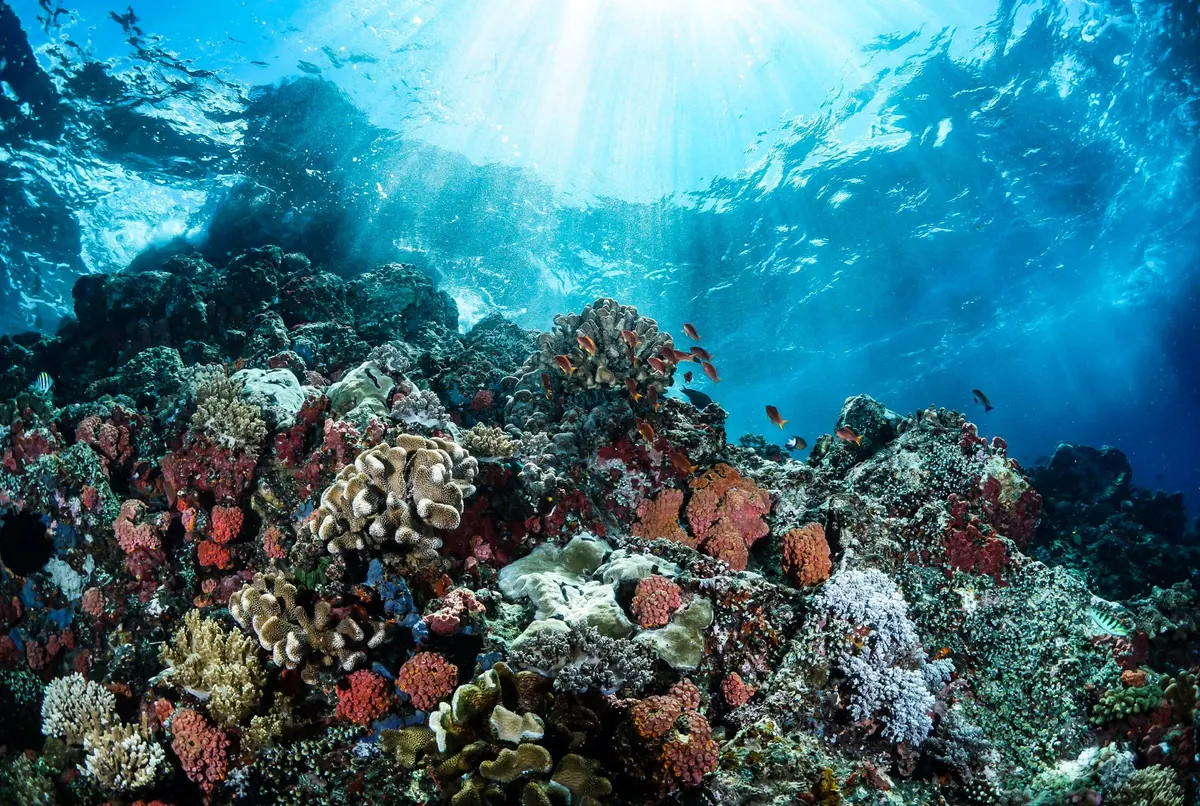
Hover a metre above a reef and the variety can feel overwhelming: boulder-like domes, branching thickets, leathery lobes swaying in the surge, feathery fans. Almost everything in front of you belongs to one of two broad groups, and once you can separate them, the whole reef starts to make sense. Hard corals and soft corals differ in skeleton, polyp structure, growth habit and the role they play. You can usually tell which is which within seconds, then refine that first guess with a closer look.
Start With the Skeleton
Hard corals — the stony corals of the group Scleractinia — build their own house. Each polyp sits in a cup-shaped skeleton of calcium carbonate called a corallite, and in a colony those cups are fused into one continuous structure. Look along a brain coral or a plate coral and you are seeing hundreds or thousands of these cups, each holding a polyp, all sharing tissue and a common skeleton. When the polyps retract, the stony surface stays visible; when the colony dies, that skeleton remains as part of the reef.
Soft corals work differently. Most species have no rigid stony frame at all. Instead they pack their tissue with tiny calcite needles called sclerites, which give a leathery or rubbery feel and offer some protection against predators. A few groups, such as sea fans and sea whips, grow an internal axis — but it is flexible rather than stony, and you can watch it bend with the swell.
Soft corals also hold themselves up with water. A polyp expands by drawing in seawater, so the same colony can look plump in a strong current and utterly limp in slack water or after dark.
Death tells the story as clearly as life: a hard coral leaves a skeleton behind, a soft coral usually leaves almost nothing.
Polyp Maths: Six Versus Eight
Get close enough to see a single polyp and you can often settle the identification on the spot. Hard corals belong to the wider group often called hexacorals, and their tentacles come in multiples of six — six, twelve, twenty-four, or such a dense mass that counting is hopeless.
Soft corals, along with sea fans, are octocorals: eight tentacles per polyp, each one feathery with small side branches. That feathery eight-part star is one of the most reliable clues on a reef, and it works on everything from a broad leathery colony to a slender sea whip.
What Each Type Builds
Only hard corals lay down the reef framework, though they are helped by coralline algae, sponges and other calcifying organisms. Their skeletons accumulate over time, layer on layer, and become the structure that later shelters fish, crustaceans and everything else. The staghorn thickets and massive porites heads you see are not just residents of the reef; they are the reef.
Soft corals are more like tenants. Many grow quickly, settle on rubble or dead coral, and compete for space by spreading tissue rather than by building. Some also use chemical defences, releasing compounds that discourage neighbours from growing over them — part of the reason soft coral gardens can look oddly bare at the edges.
Both types, it is worth remembering, usually host microscopic algae called zooxanthellae in their tissue. Those algae photosynthesise and supply the coral with much of its energy, which is why light matters so much to a reef's layout. Neither group is purely a plant, and neither is purely a predator; most colonies do a bit of both, capturing plankton when they can.
Where You Will Find Them
Light, current and water quality sort the two groups into different neighbourhoods, and reading those patterns helps you predict what you are looking at.
- Reef crest and upper slope: hard corals dominate, built for strong light and heavy surge.
- Lagoons and back reefs: soft corals and hardy hard corals, coping with warmer, calmer, sometimes murkier water.
- Overhangs, caves and deeper reef: soft corals, sea fans and other filter feeders, often hanging into the current.
- Sediment-heavy or nutrient-rich areas: soft corals frequently outcompete stony corals, which smother more easily.
Some soft corals, such as the brightly coloured tree corals, do not host zooxanthellae at all and depend entirely on catching plankton from passing current. Find them on a wall or under a ledge with flow, and you will see the polyps open.
Identification Tips You Can Use in the Water
- Check the surface texture. Stony, gritty and repetitive suggests hard coral; smooth, leathery, slippery or slightly fuzzy suggests soft coral.
- Watch for movement. If the colony sways, pulses or folds in the surge, it is soft. Hard corals stay rigid even in strong swell.
- Look at the base. A clear stony attachment to the substrate, with visible cups or ridges, points to a hard coral.
- Count tentacles if you can — eight feathery ones means octocoral, multiples of six means hard coral.
- Note the shape. Fingers, lobes, fans, whips and mats are typical soft coral forms; domes, plates, branches and encrusting sheets are more often stony.
- Use a torch on a night dive. Retracted polyps expose the skeleton, which makes hard corals obvious.
Common Misidentifications
A few species refuse to fit neatly into either box, and knowing them saves you an argument later. Fire corals look stony and often yellow-brown with pale tips, but they are hydrocorals, more closely related to jellyfish, and they sting. Blue coral builds a hard skeleton yet is an octocoral. Mushroom corals sit alone rather than in colonies and can look fleshy, but each one is a single large stony polyp. And a dead hard coral colonised by algae or turf will often read as soft at first glance, so look for the underlying cups and ridges.
Practise on Your Next Snorkel or Dive
Pick one colony per dive and study it rather than swimming the whole reef. Spend a full minute on it: where it grows, what the surface does in the current, whether polyps are open, what the tentacles look like up close. Photograph it from the side and from directly above, then check the images afterwards — the differences are far easier to see on a screen than through a mask.
Keep your hands off everything, though. Touching damages soft coral tissue, breaks stony branches and rubs off the protective mucus layer that keeps corals healthy; some species, including fire coral, will also sting you. Many reefs are legally protected, and in marine reserves even touching is an offence. Buoyancy control, a torch, a slate and a willingness to hover still will teach you more about hard corals and soft corals than any amount of swimming past.
Photo: mariya_m / Pixabay